Your latest post is super interesting. Lots of devs share their tools. So this is always a winner. But I'm still waiting on a groundbreaking article named: "How I Distribute My Games To Make Lots Of Mula!" ^^ Come on Chris, be a pioneer, think about the Bro Code. I'll help you out: "The bond between two brogrames is stronger than the bond between a brogrammer and a random guy because, on average, brogramers are not random. That’s just science."
Your latest post is super interesting. Lots of devs share their tools. So this is always a winner. But I'm still waiting on a groundbreaking article named: "How I Distribute My Games To Make Lots Of Mula!" ^^ Come on Chris, be a pioneer, think about the Bro Code. I'll help you out: "The bond between two brogrames is stronger than the bond between a brogrammer and a random guy because, on average, brogramers are not random. That’s just science."
The problem with the a post named How I Distribute My Games To Make Lots Of Mula is that what works for one game is not necessarily what works well for another. In the end it’s all down to how many users you can get to play your game and good distribution is more about throwing everything on the wall and see what sticks than it is a recipe that can be followed step by step.
Overall the most powerful thing that can happen to you is getting featured, either organically, by being in the download top-lists or inorganically, by interacting with each app stores review team.
I have yet to actually make the second happen, but have been lucky to have Hex FRVR have enough organic downloads to reach the top lists. So how did I get these organic downloads? By having games that are easy to share on social networks.
This is why I make HTML5 games with a huge focus on cross browser device support and total download size. Looking at Hex FRVR, the game playable after only about 250kb of download via 9 HTTP requests. The result is an average time from clicking a link to actually playing in less than 3 seconds for pretty much anywhere in the world.
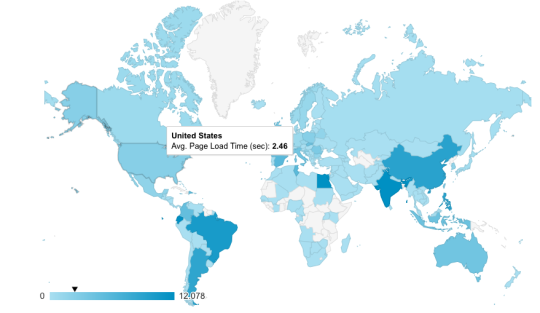
(The lighter the color, the faster the game load time)
The secound most important source of traffic is organic discovery via search or app store recommendation (E.g. related games in the iTunes App Store). Here pretty much all the stores work the same, you proportionally get as much promotion as how well your game performed compared to other games in your category or search term. Some platforms are simplistic, looking at only your average rating from users. Others such as the Facebook web platform also look at average session time and recency.
In short, unless you have a game that is actually pretty good compared to the games in your category, you won’t get a lot of traffic this way. (This is where it actually matters if you make a good game, you wanna be at-least in top 10%). Note here that what you might deem as quality typically has less to do with what the users actually want to play. The users won’t care much about the depth of your gameplay if your game is very hard to get started on initially.
The 3rd most important source of traffic, in my opinion is your ability to be on multiple platforms. It’s not that hard making $5/day on one platform, and so far I found it easier to make $5/day more by adding one more platform than it is to grow the game with the same amount on one platform. (This at-least holds true as until you covered all the obvious major platforms).
And now I am pretty sure your thinking Dude I already know this, whats wrong with you, just giving a wage answer when I ask or specifics? To which I can only reply, there is no magic bullet. It’s very much down to every individual game.
Essentially you have to:
- Identify the user who are likely to play your game
- Figure out where those users go on the internet
- Figure out how get those places to promote your game.
I find that step #3 to be the hardest, at-least when working with games that does create enough revenue to allow for a paid user acquisition flow.
For Hex FRVR I was super lucky, a Reddit post was enough to kickstart the social distribution to the point where the game entered into the download top-lists on the iTunes App Store. Much more information. For Solitaire FRVR I was not that lucky and all traffic was fairly painstakingly build by releasing on as many platforms I could, then write literally hundreds of emails to people with traffic that might show it to their users.
The only big exception to the above is traffic you control yourself. For instance, imagine you have 25 medium sized games live across 5 platforms each. Now you are at a size where you can redirect users, already playing your games, to your new games. Thereby pushing your games into the top-lists inorganically yourself. (This is where the publishers have the advantage, and why it’s fairly easy for King.com to get into into the top-lists). Similarly it’s beneficial to make sure you have as many ways of talking to your previous users as possible. Think Facebook Pages, Email newsletters etc.
As for effort, be prepared to spend at-least as much time distributing your game as you did actually making it. Unless you are super lucky, like I was with Hex FRVR, you are in for a long hard grind that will likely span multiple games before your hit your first success.